



Submit invoices to every authority. One API.

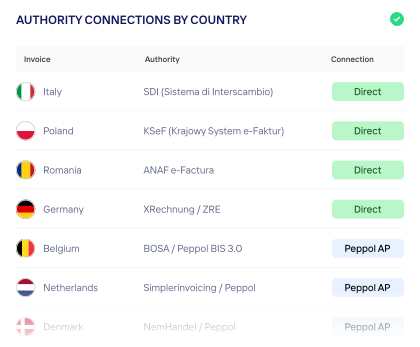










Direct authority connections. A specialist behind every filing. Most e-invoicing APIs return a status code and leave rejections to your engineers. Taxually generates the right format for each country, submits it to the tax authority, and alerts you the moment an invoice is accepted or rejected. VAT specialists stand behind every integration, so rejected invoices get resolved instead of blocking your cash flow. No six-month implementation project.
One connection. Every mandate. Ready before the deadline moves.
Building for each mandate

E-invoicing with Taxually

How it works
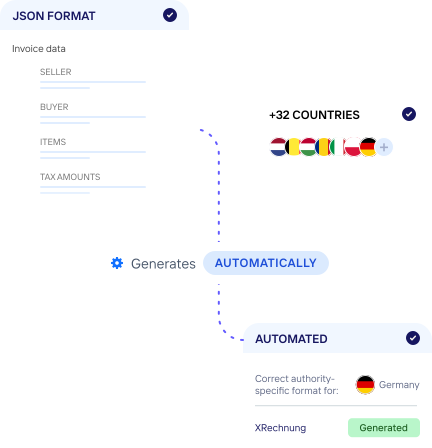
Send invoice data
Our e-invoicing suite generates and submits
Clearance status returned
What our e-invoicing suite handles
Direct authority connections.
Not a Peppol overlay.
Single common data model One integration covers all 32 countries
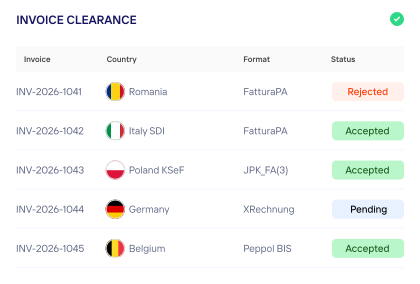
Structured clearance status Pending, accepted, rejected, error

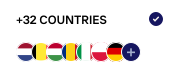
32 countries. One connection, every mandate
accessible from the same API.



When structured e-invoicing becomes mandatory in each market. Taxually keeps pace so you're ready before the deadline.
E-invoicing questions, answered
Which countries require e-invoicing for B2B transactions?
As of October 2026, mandatory B2B e-invoicing is live in Italy, Poland, Belgium, Croatia, Romania, France (large and mid-sized companies) and Greece (larger businesses). Germany already requires businesses to be able to receive e-invoices and phases in issuing through 2028, and Spain, Slovakia and Latvia follow in 2027–2028. From 1 July 2030, the EU's ViDA package adds e-invoicing for intra-EU B2B trade. Dates change often, so check each country's tax authority before you act.
What is Peppol and does Taxually use it?
Peppol is an international network and set of standards for exchanging structured e-invoices through certified access points. Taxually is a certified Peppol Access Point (PIE001162, BIS Billing 3.0). It also connects directly to tax authority platforms that don't run on Peppol, such as Italy's SDI, Poland's KSeF, Romania's ANAF and Greece's myDATA.
What is the difference between FatturaPA, XRechnung, KSeF, and UBL 2.1?
They are country-specific structured invoice formats. FatturaPA is Italy's XML format for the SDI, XRechnung is Germany's standard based on the European norm EN 16931, KSeF uses Poland's FA structured schema, and UBL 2.1 is the international XML syntax used on the Peppol network. With Taxually you send one invoice payload in a common data model, and the correct format is generated for each destination country.
How does Taxually handle asynchronous clearance — like Italy's SDI?
Some authorities, such as Italy's SDI, confirm invoices asynchronously. Taxually returns a PENDING status while the authority processes the invoice (around 30 seconds for SDI), then ACCEPTED with the authority's reference number or REJECTED with the specific error code. You can receive the result by webhook or by polling the status.
What is the France e-invoicing mandate and when does it apply?
France is moving domestic B2B invoicing to structured e-invoices exchanged through approved platforms (plateformes agréées), with e-reporting for B2C and cross-border sales. Since 1 September 2026, all businesses must be able to receive e-invoices and large and mid-sized companies must issue them. Small and micro-enterprises must issue e-invoices from 1 September 2027.
Can Taxually's e-invoicing integrate with my ERP or billing platform?
Yes. The e-invoicing API accepts invoice data in one common JSON format from any ERP, billing or invoicing system that can make an API call, so a single integration covers all 32 supported countries. Book a demo to check the set-up for your specific platform.
What happens if an invoice is rejected by the authority?
You receive a REJECTED status with the authority's specific error code, so your team sees exactly what to fix before resubmitting. Taxually's VAT specialists stand behind every integration and help resolve rejected invoices, so they don't block the sale or your cash flow.