Key takeaways
- Check seven features: calculation, registration, filing, payments, EPR, integrations and audit trail with validation.
- Calculation engines (Avalara, Vertex, Sovos) lead inside checkout and ERP; service-led platforms like Taxually lead on registration, filing, payment and EPR.
- Ask every vendor who files, who pays, which countries are covered and what happens when there is no integration.
In short: Automated tax compliance software should cover seven must-have features: tax calculation, registration (including fiscal representation), return filing, tax payments, EPR and environmental taxes, ERP and marketplace integrations, and an audit trail with data validation. Few tools do all seven equally well. Calculation engines such as Avalara, Vertex and Sovos are strongest inside checkout and ERP systems. Service-led platforms such as Taxually focus on registration, filing, payment and EPR across countries.
Updated October 2026: We rewrote this guide as a neutral buyer's checklist, added vendor questions for each feature and a comparison of Taxually, Avalara, Vertex and Sovos (which now includes Taxware) based on their own product pages in October 2026.
Tax compliance is no longer just about filing forms on time. Businesses that sell across borders face VAT, GST, US sales tax and, increasingly, packaging and electronics levies. Spreadsheets break as the number of countries grows. For a real-world example, read our Gelato case study.
This checklist explains what each feature is, why it matters and what to ask vendors before you sign. Taxually wrote it, so we have kept competitor facts to each vendor's own pages and listed every source at the end. For the enterprise architecture angle, see Reengineering Tax Compliance for Enterprises with API-First Platforms.
What are the 7 must-have features of automated tax compliance software?
The seven features below cover the full compliance cycle, from the first sale to the final payment and audit.
- Tax calculation: the right rate on every transaction.
- Registration: getting tax numbers, including fiscal representation where required.
- Return filing: preparing and submitting returns to each authority.
- Tax payments: paying what you owe, on time and in the right currency.
- EPR and environmental taxes: packaging, electronics, battery and plastic levies.
- Integrations: pulling data from ERPs, marketplaces and payment platforms.
- Audit trail and data validation: catching errors before filing and proving your numbers later.
E-invoicing is now a strong add-on too, because more countries require structured invoices cleared through government systems.
1. Why does accurate tax calculation matter?
Tax calculation matters because every later step depends on it. If the rate is wrong at checkout or on the invoice, the return, the payment and the audit file are wrong too.
Calculation means applying the correct VAT, GST or sales tax rate to each transaction. In the US that can depend on the state, county, city and special district. In Europe it depends on the product, the customer type and where goods ship. Good tools also monitor thresholds, so you know when a new obligation starts.
Questions to ask vendors:
- Do you calculate tax in real time at checkout, or after the fact from sales data?
- Which countries and US jurisdictions do you cover, and how quickly do you apply rate changes?
- Do you monitor distance-selling and economic nexus thresholds for us?
2. Why do you need registration and fiscal representation?
You need registration support because you cannot file or collect tax legally until you hold a valid number in each country or state.
Registration rules vary widely. Some countries require non-resident companies to appoint a fiscal representative who shares liability for the VAT. Registration also comes first in time: a slow registration can delay your launch in a new market. Ask whether the vendor handles deregistration too.
Questions to ask vendors:
- In which countries can you register us, and how long does it usually take?
- Can you act as our fiscal representative where it is required?
- Do you handle deregistration and tax authority letters?
3. Why does automated return filing matter?
Automated filing matters because preparing returns by hand is slow and error-prone, and late or wrong returns lead to penalties.
A strong tool turns validated transaction data into returns in each country's format and submits them. In the EU that includes One-Stop Shop (OSS) and Import One-Stop Shop (IOSS) returns. In the US it means state returns with their own schedules. Check who actually presses submit: the software, your team or the vendor's experts.
Questions to ask vendors:
- Do you file on our behalf, or do we submit returns ourselves?
- Which return types do you support (VAT, OSS, IOSS, EC Sales Lists, US state returns)?
- Who reviews returns before submission, and what happens if a return is rejected?
4. Why should the software handle tax payments?
Payment handling matters because a correct return paid late or to the wrong account still creates penalties.
Paying many tax authorities means many bank transfers, currencies and payment references. Some providers remit on your behalf as part of a managed service. Others leave payment to you. Consolidated payment can cut bank fees and the risk of a wrong reference.
Questions to ask vendors:
- Do you remit tax for us, and in which countries?
- Can we fund all payments in one transfer and one currency?
- How do we see payment status and proof of payment?
5. Why do EPR and environmental taxes belong on the checklist?
EPR belongs on the checklist because many sellers of physical goods now owe packaging, electronics or battery obligations next to VAT, and few tax tools cover them.
Extended producer responsibility (EPR) requires producers to register, report volumes and pay producer responsibility organizations (PROs). Spain also has a plastic packaging tax. These rules sit outside most VAT and sales tax engines, so buyers often need a separate provider. Our overview of EPR obligations by country explains the rules.
Questions to ask vendors:
- Do you cover EPR registration, reporting and PRO payments?
- Which countries and product categories (packaging, WEEE, batteries, textiles) do you support?
- Do you cover plastic taxes as well?
6. Why do ERP and marketplace integrations matter?
Integrations matter because tax software is only as accurate as the data it receives, and manual exports add errors.
Large companies need connectors to ERP and billing systems. Online sellers need marketplace and payment platform feeds such as Amazon, Shopify or Stripe. Ask how the tool handles data from systems without a ready-made connector. Read more on choosing a delivery model in our guide to the co-sourced tax compliance model.
Questions to ask vendors:
- Which ERP, marketplace and payment integrations do you offer today?
- What happens if our system has no connector? Can you map our files?
- How long does onboarding take, and who does the setup?
7. Why do you need an audit trail and data validation?
You need an audit trail and data validation because tax authorities can question your returns years later, and bad data is the most common cause of wrong filings.
Validation checks transactions before filing, for example missing VAT numbers, wrong addresses or duplicate records. An audit trail records who changed what and keeps the documents behind each return. Together they make audits faster and less risky. For nexus-specific checks, see how to determine your sales tax nexus exposure.
Questions to ask vendors:
- What validation rules run before a return is filed? Can we add our own?
- Do you keep an audit log and archive of returns and supporting documents?
- Do you validate customer addresses and VAT numbers?
What about e-invoicing?
E-invoicing is an add-on worth checking now, because more countries require invoices to be issued in structured formats and cleared or reported to the tax authority. If you invoice businesses in mandate countries, ask how many countries the vendor covers and whether it supports Peppol and clearance models.
How do Taxually, Avalara, Vertex and Sovos compare on the 7 features?
Each vendor covers most features, but with different strengths. The table uses each vendor's own product pages as of October 2026. "Not listed" means we found no such product on the vendor's pages, not that it can never be arranged.
A note on Taxware: Taxware, one of the oldest US sales tax engines, merged with Convey and VAT Resource in 2014. The combined company was renamed Sovos Compliance in 2015, and Sovos traces its history to Taxware. So the Sovos column covers former Taxware products.
| Feature | Taxually | Avalara | Vertex | Sovos (incl. former Taxware) |
|---|---|---|---|---|
| 1. Tax calculation | Yes. Rate per transaction for VAT, GST and sales tax; threshold monitoring | Yes. AvaTax real-time engine, 12,000+ US jurisdictions | Yes. O Series inside ERP, 19,000 jurisdictions | Yes. Real-time determination for SUT, VAT and GST, 185+ countries |
| 2. Registration and fiscal representation | Yes. VAT registration in any country plus fiscal representation (CrossTax) | Yes. Registration in 53 countries; fiscal representation where required | Partial. Local agents register where needed; fiscal representation not listed | Yes. Outsourced VAT registration and local fiscal representation |
| 3. Return filing | Yes. VAT incl. OSS and IOSS; US and Canada via LumaTax (enterprises and service providers) | Yes. VAT returns in up to 53 countries; US Managed Returns | Yes. VAT Compliance Service and US SUT compliance | Yes. VAT, sales tax and SAF-T filing |
| 4. Tax payments | Yes. OneTax: one bulk payment for 30 countries where Taxually is fiscal representative | Partial. Remittance within Managed Returns; no multi-country VAT payment service listed | Yes. VAT service customers fund Vertex in EUR or USD; Vertex pays authorities | Partial. US filing service includes remittance; VAT payments not described |
| 5. EPR and environmental taxes | Yes. Germany, France, Spain plus Spanish plastic tax (EcoTax) | Not listed | Not listed | Not listed |
| 6. ERP and marketplace integrations | Yes. Amazon, eBay, Shopify, Stripe, Excel/CSV, ERP and accounting platforms, custom file mapping | Yes. 1,400+ partner integrations | Yes. SAP, Oracle, Workday, Microsoft Dynamics, NetSuite and others | Yes. ERP integration, SAP Tax Determination; Shopify Tax filing partner since 2025 |
| 7. Audit trail and data validation | Yes. 250+ validation rules, custom rules, audit log, address validation (LumaTax) | Yes. Audit trail of every transaction; address validation | Partial. Reporting and address cleansing listed; audit trail not described on O Series page | Yes. Full audit trail of accounts in VAT managed services |
| Add-on: e-invoicing | Yes. 32 countries | Yes. Global API, Peppol Access Point | Yes. 37 countries listed | Yes. 60+ countries, Peppol |
For deeper head-to-head reviews, read Taxually vs Avalara and Taxually vs Vertex.
Which tool fits which business?
The best fit depends on where your tax is determined and who you want to do the compliance work.
- US-focused online seller that needs tax at checkout: Avalara is a strong fit, with real-time calculation and many e-commerce connectors.
- Global enterprise on SAP, Oracle or Workday: Vertex or Sovos suit tax determination inside the ERP.
- Company facing many e-invoicing mandates: Sovos and Vertex publish the widest e-invoicing country coverage.
- Seller registered for VAT in several countries without a large tax team: Taxually handles registration, fiscal representation, filing and payment as a service.
- Brand selling physical goods into Germany, France or Spain: Taxually covers VAT and EPR in one place.
Many larger groups combine tools: an engine for real-time calculation and a service provider for registrations, filings and payments. Agree clearly who files each return. Our article on enterprise risk with global VAT compliance software covers the governance side.
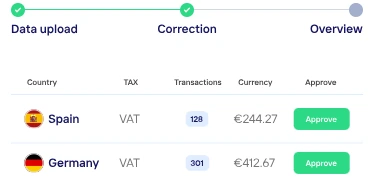
How does Taxually handle the 7 features?
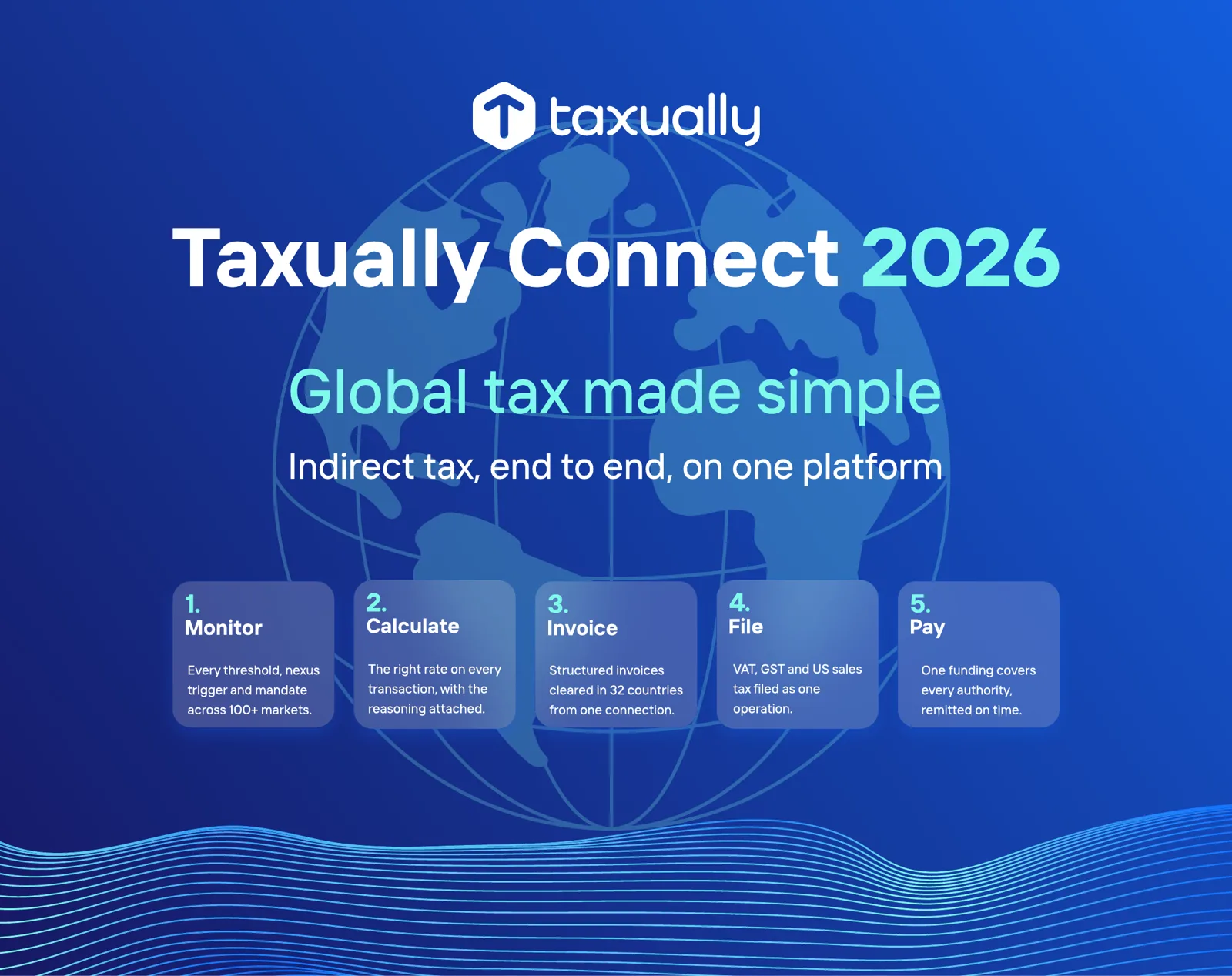
Taxually is an international tax management platform that monitors, calculates, invoices, files and pays VAT, GST and sales tax. Here is how it maps to the checklist:
- Calculation: applies the right VAT, GST or sales tax rate per transaction, at up to 40,000 calculations per minute, and monitors thresholds across 100+ markets.
- Registration: CrossTax registers you for VAT in any country and can act as fiscal representative.
- Filing: CrossTax files VAT returns, including OSS and IOSS, on your behalf. LumaTax files US and Canadian sales tax returns; it is currently available to enterprises and service providers.
- Payments: OneTax lets fiscal representation clients pay VAT in 30 countries with one bulk payment in their chosen currency.
- EPR: EcoTax handles EPR registration, reporting and PRO payments in Germany, France and Spain, plus the Spanish plastic tax.
- Integrations: Amazon, eBay, Shopify, Stripe, Excel/CSV and ERP and accounting platforms, with custom file mapping where no connector exists.
- Audit trail and validation: 250+ validation rules, custom rules and an audit log.
- E-invoicing: structured e-invoices cleared in 32 countries.
Tax experts are part of the service, and support is available in 13+ languages. Ready to see it on your own data? Book a free demo.
Sources
- Avalara: AvaTax calculations
- Avalara: VAT Returns and Reporting
- Vertex: O Series
- Vertex: VAT Compliance Service
- Vertex: e-Invoicing
- Sovos: Tax Determination
- Sovos: VAT Managed Services
- Sovos: Sales and Use Tax Filing Managed Services
- Sovos: Indirect Tax Suite
- Sovos: Shopify partnership (June 2025)
- Sovos: renamed Sovos Compliance in 2015 after the Taxware merger (company history)
How Taxually handles this
Taxually’s CrossTax handles VAT registration, VAT, OSS and IOSS returns and fiscal representation in the countries you sell into, and checks your sales data against 250+ validation rules before each filing. OneTax then pays every tax authority with one bulk payment in your chosen currency.
Related guides

Frequently asked questions
What are the 7 must-have features of automated tax compliance software?
Tax calculation, registration (including fiscal representation), return filing, tax payments, EPR and environmental taxes, ERP and marketplace integrations, and an audit trail with data validation. E-invoicing is a useful add-on.
What is automated tax compliance software?
It is software that calculates, files and often pays VAT, GST and sales tax for you, using your transaction data. It cuts manual work and errors and keeps up with rule changes across countries and states.
Is Taxware still a separate company?
Taxware merged with Convey and VAT Resource in 2014, and the combined company was renamed Sovos Compliance in 2015. Sovos traces its history to Taxware, so former Taxware products now sit within Sovos.
Which tax compliance software covers EPR?
Of the vendors compared here, only Taxually lists an EPR product. Its EcoTax service covers Germany, France and Spain, plus the Spanish plastic tax. Avalara, Vertex and Sovos did not list EPR products on their pages in October 2026.
Do I need a calculation engine or a compliance service?
It depends where your tax is determined. If you need tax calculated live in checkout or an ERP, an engine such as Avalara, Vertex or Sovos fits. If you need registrations, filings, fiscal representation and payments handled across countries, a service-led platform such as Taxually fits. Many larger groups use both.
What should I ask a tax compliance software vendor?
- Which countries and states do you cover for registration and filing?
- Do you file and pay on our behalf?
- Which integrations do you offer, and what happens without one?
- What validation runs before filing, and do you keep an audit log?
Can tax automation software integrate with my existing systems?
Yes. Most vendors connect to ERP, marketplace and payment systems. Taxually integrates with Amazon, eBay, Shopify, Stripe, Excel/CSV and ERP and accounting platforms, and uses custom file mapping where no connector exists.